
C Major Scale for Piano Beginners
The C major scale is usually the first piano scale beginners learn. It is simple, easy to understand, and helps build a strong foundation for piano playing and music theory.
Because the C major scale uses only white piano keys, it allows beginners to focus on finger movement, rhythm, and hand coordination without worrying about sharps and flats.
Learning the C major scale can improve your piano technique, strengthen your fingers, and help you understand how music works.
What Is the C Major Scale
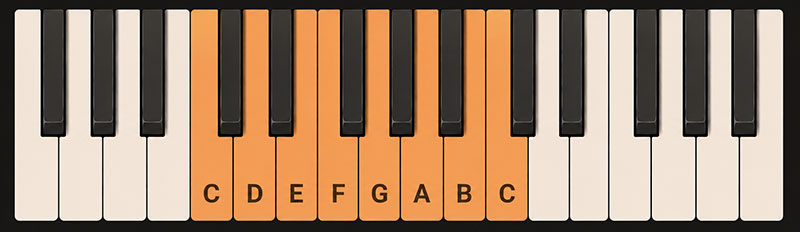
The C major scale is a sequence of eight notes played in order from low to high.
The notes of the C major scale are:
C D E F G A B C
All of these notes are played on white piano keys.
The scale starts on C and ends on the next C one octave higher.
Why Beginners Start with the C Major Scale
The C major scale is one of the easiest scales to understand visually on the piano keyboard.
- Uses only white keys
- No sharps or flats
- Easy to memorize
- Helps develop finger coordination
- Builds confidence for beginners
- Introduces basic music theory
For many piano students, the C major scale becomes the foundation for learning other scales later.
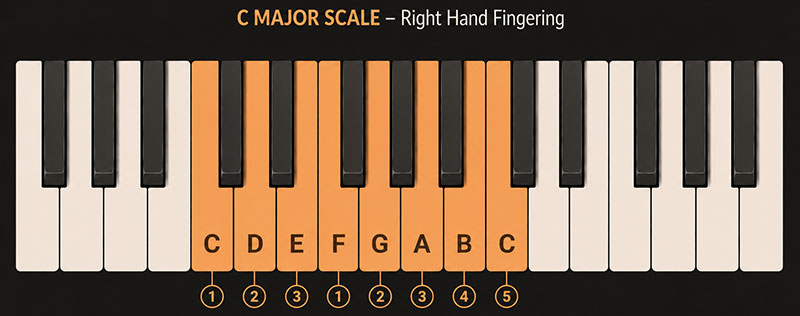
Right Hand Fingering for the C Major Scale
Using the correct fingering helps your hand move smoothly across the keyboard.
The right hand fingering for the C major scale is: 1 2 3 1 2 3 4 5
Your thumb goes under your hand after the third note to continue the scale smoothly.
At first this movement may feel unusual, but it becomes natural with practice.
Left Hand Fingering for the C Major Scale
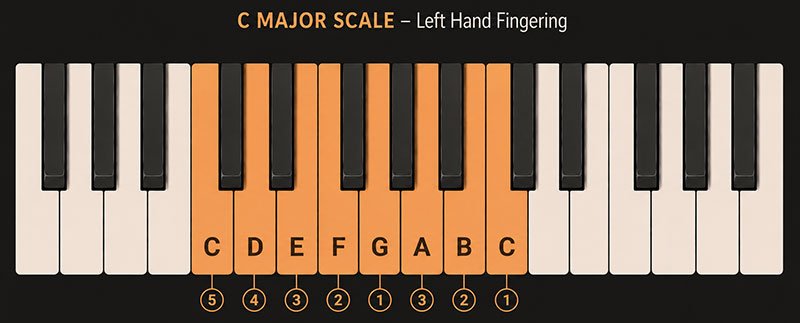
The left hand uses a different fingering pattern.
The left hand fingering is: 5 4 3 2 1 3 2 1
Your middle finger crosses over the thumb during the scale.
Practice slowly so your movements stay relaxed and comfortable.
How to Practice the C Major Scale
Many beginners try to play scales too quickly. Slow practice usually gives better results.
- Practice slowly
- Keep a steady rhythm
- Relax your hands
- Use correct fingering
- Focus on accuracy
- Practice every day
Even a few minutes of daily scale practice can improve your coordination and confidence.
Practice One Hand at a Time
Beginners often find it easier to learn scales one hand at a time before combining both hands together.
This allows you to focus on fingering, rhythm, and smooth hand movement more comfortably.
Once both hands feel confident separately, try playing the scale with both hands together slowly.
Use a Metronome
A metronome helps you keep a steady rhythm while practicing piano scales.
Start at a slow tempo and increase the speed gradually as your confidence improves.
Do not rush. Good technique is more important than fast playing.
How the C Major Scale Helps Piano Beginners
Practicing the C major scale regularly can improve many important piano skills.
- Finger strength
- Hand coordination
- Rhythm control
- Keyboard awareness
- Music reading skills
- Understanding of music theory
The C major scale also prepares beginners for learning chords, songs, and more advanced scales.
Common Mistakes Beginners Make
Learning scales takes patience. Beginners often make a few common mistakes when practicing.
- Playing too fast
- Using incorrect fingering
- Tensing the hands
- Skipping slow practice
- Ignoring rhythm
- Practicing inconsistently
Focusing on relaxed and steady practice will help you improve much faster.
Learning Piano at Any Age
Many adults and older beginners successfully learn the C major scale every day. It is never too late to start learning piano.
Short and consistent practice sessions are often more effective than long practice sessions once a week.
Patience and regular practice are the keys to progress.
What to Learn After the C Major Scale
Once you feel comfortable with the C major scale, you can continue learning other important piano skills.
- G major scale
- F major scale
- Basic piano chords
- Simple songs
- Rhythm exercises
- Sheet music reading
Each new skill will help strengthen your understanding of music and improve your piano playing.
Frequently Asked Questions
What notes are in the C major scale?
The C major scale contains the notes C D E F G A B C.
Why is the C major scale easy for beginners?
The C major scale uses only white piano keys and does not include sharps or flats.
How often should I practice the C major scale?
Daily practice is best. Even five to ten minutes each day can improve technique and coordination.
Should I practice scales with both hands?
Yes, but beginners should usually practice one hand at a time first before combining both hands together.
What comes after learning the C major scale?
Many beginners continue with G major scale, F major scale, chords, rhythm exercises, and simple piano songs.
Can adults learn the C major scale?
Yes. Adults of all ages can successfully learn piano scales with regular and patient practice.