
Carl Czerny: More Than Just Exercises
For many pianists, the name Carl Czerny instantly brings to mind pages of fast notes, strict fingerings, and relentless repetition. He’s often treated as a rite of passage—something to endure on the way to “real music.” But this reputation tells only a small part of the story. In truth, Czerny was one of the most influential figures in piano pedagogy, and his work continues to shape how pianists learn today.
-
How Many Piano Pieces Should a Beginner Learn at the Same Time?
How Many Piano Pieces Should a Beginner Learn at the Same Time? When I started learning piano, I thought the best approach was simple: choose one piece, practise it until…
-
Why Beginner Piano Pieces Are Harder Than They Look
Why Beginner Piano Pieces Are Harder Than They Look When you open a beginner piano piece, it can look surprisingly simple. There may be only a few notes in each…
-
Ferdinand Beyer: Why His Piano Method Is Still Useful for Beginners
Ferdinand Beyer: Why His Piano Method Is Still Useful for Beginners When learning piano today, it is easy to assume that newer teaching materials must automatically be better. Modern methods…
-
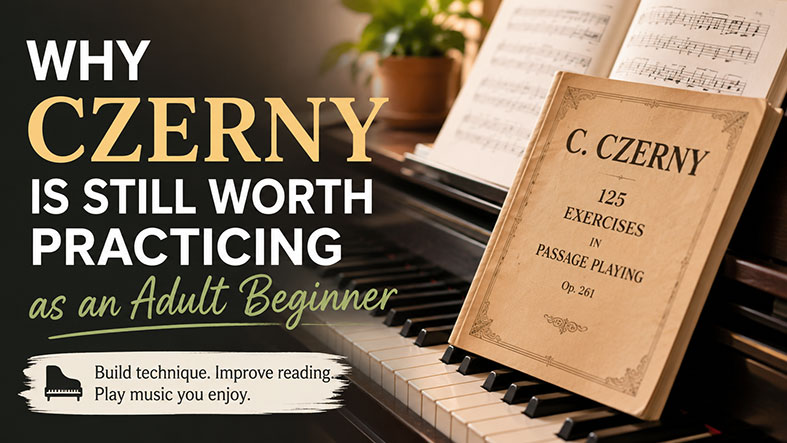
Why Czerny Is Still Worth Practicing as an Adult Beginner
Why Czerny Is Still Worth Practicing as an Adult Beginner When I first came across the name Carl Czerny, I associated him mainly with exercises: pages of notes designed to…
-
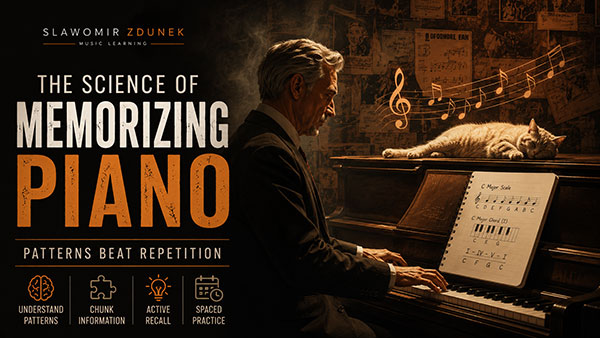
The Science of Memorizing Piano: Why Patterns Beat Repetition
The Science of Memorizing Piano: Why Patterns Beat Repetition “Practice doesn’t make perfect. Perfect practice builds understanding.” One of the biggest misconceptions among beginning pianists is that learning scales, chords,…
-
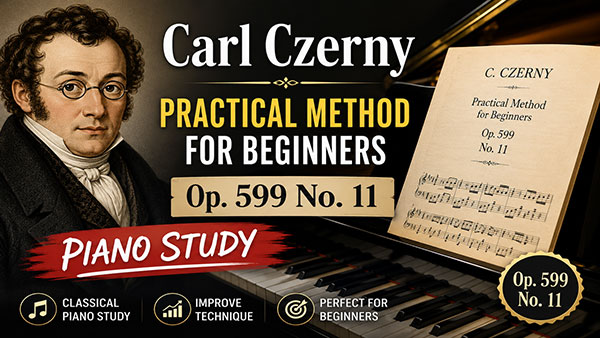
Carl Czerny Practical Method for Beginners Op 599 No 11
Carl Czerny Practical Method for Beginners Op. 599 No. 11 is one of the most useful studies for developing a solid piano technique. Although it is written for beginners, it…
-
Carl Czerny Op 599 No 10
Carl Czerny Op 599 No 10 Learning piano is a dream that many people carry for years. Some people begin as children, while others decide to start much later in…
-
Czerny Op. 599 No. 9
My Journey with Czerny Op. 599 No. 9 – A Beginner’s Piano Milestone Learning the piano is a journey full of small wins, challenges, and moments of real progress. Today,…
-
Czerny Op. 599 No. 8
Carl Czerny’s Practical Method for Beginners, Op. 599 is one of the most widely used piano books for early learners. Exercise No. 8 is an important step in this method.…
-

Czerny Op. 599 No. 7
Czerny Op. 599 No. 7 — A Simple Exercise That Isn’t So Simple At first glance, Carl Czerny’s Practical Method for Beginners, Op. 599 No. 7 looks like a straightforward…
A Student of Beethoven, a Teacher of Generations
Born in Vienna in 1791, Czerny was a child prodigy who studied directly with Ludwig van Beethoven. This connection matters: Czerny absorbed Beethoven’s ideas about clarity, structure, and articulation firsthand. Later, as a teacher, he passed these principles on to hundreds of students—including Franz Liszt, one of the greatest virtuosos in piano history.
Czerny stood at a crossroads between the Classical and Romantic eras. His teaching bridged the elegance of Mozart and Haydn with the technical demands of later composers like Chopin and Liszt.
Why Did Czerny Write So Much?
Czerny was astonishingly prolific, writing hundreds of studies and methods. His goal wasn’t to create concert repertoire, but to solve practical problems pianists face:
- Weak or uneven fingers
- Poor coordination between hands
- Insecure reading
- Lack of control at faster tempos
Collections such as Op. 599 (Practical Method for Beginners), Op. 849, and Op. 299 (School of Velocity) are carefully graded. Each piece focuses on a specific technical challenge while gradually increasing musical and physical demands.
Are Czerny’s Studies Really “Unmusical”?
This is perhaps the most common criticism of Czerny—and also the most misunderstood. While his studies aren’t emotionally expressive in the Romantic sense, they are musically logical. They train pianists to:
- Shape phrases
- Control articulation
- Balance voices
- Play evenly and clearly
When practiced with attention to dynamics, touch, and direction, Czerny’s music becomes far more engaging than its reputation suggests. The problem is rarely the notes themselves, but how they are practiced.
Czerny in Modern Piano Study
Despite changes in teaching styles, Czerny remains highly relevant. Many modern pianists use his studies alongside repertoire to build reliable technique. His exercises are especially valuable because they:
- Prepare students for classical composers like Mozart and Beethoven
- Lay the groundwork for Romantic virtuosity
- Teach efficient, economical movement at the keyboard
Rather than replacing musical pieces, Czerny works best as a support system—a way to strengthen the hands so musical ideas can be expressed freely.
A Shift in Perspective
If we stop viewing Czerny as a necessary evil and instead see him as a craftsman of piano technique, his value becomes clear. His music teaches discipline, awareness, and control—qualities that every pianist, beginner or advanced, ultimately needs.
Czerny may not always sing, but he teaches your fingers how to listen.
Final Thoughts
Carl Czerny’s legacy isn’t about flashy melodies or dramatic gestures. It’s about building a solid foundation—quietly, patiently, and effectively. For pianists willing to approach his music thoughtfully, Czerny offers something invaluable: the tools to play everything else better.