Why Beginner Piano Pieces Are Harder Than They Look
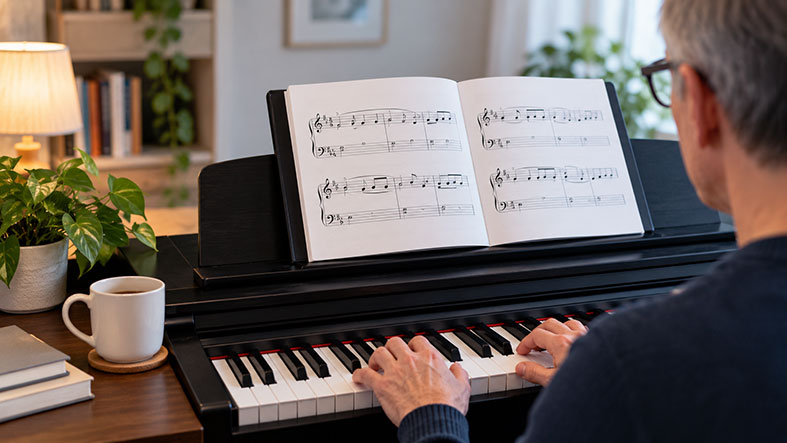
When you open a beginner piano piece, it can look surprisingly simple. There may be only a few notes in each hand, an uncomplicated rhythm and perhaps a basic chord or two in the left hand. At first glance, it can seem like something you should be able to learn very quickly.
Then you sit at the piano and try to play it.
The right hand might be easy on its own, and the left hand might also be manageable. But when you put the two hands together, things suddenly become much more difficult. Even after learning all the notes, you may notice that the rhythm is uneven, the left hand is too loud or there are small pauses whenever you need to change position.
As an adult beginner, I am discovering that there is a big difference between playing the correct notes and playing a piece well. A beginner piece may look easy on the page, but it can still teach you a surprising amount about piano playing.
Learning the Notes Is Only the First Step
When I start learning a new piece, most of my attention naturally goes to finding the correct notes. I need to work out where my hands should be, which fingers to use and what each hand is supposed to do.
Once the notes become more familiar, however, I start noticing other things. Perhaps the tempo changes slightly when I reach a difficult measure. Maybe one note is much louder than the others, or there is a small hesitation before a chord.
I might technically be playing all the correct notes, but the piece still doesn’t sound smooth or musical.
This is where an easy piece can become surprisingly challenging. Finding the notes is only one part of learning it. Rhythm, coordination, dynamics, articulation and phrasing all matter too.
Playing With Two Hands Is a Skill of Its Own
One of the biggest challenges for me as an adult beginner is coordinating both hands. Sometimes I can play the right-hand part comfortably and then play the left-hand part without much trouble. As soon as I combine them, however, everything becomes more complicated.
The difficulty isn’t necessarily in either hand individually. It is often in the relationship between the two hands. One hand may need to hold a note while the other moves, or both hands may play together before immediately doing something different.
This is why practising hands separately can be useful, but it doesn’t completely solve the problem. At some point, the brain has to learn how the two parts fit together.
Even a piece containing only a few notes can provide valuable coordination practice.
Simple Rhythms Aren’t Always Easy to Play
Beginner pieces usually don’t contain extremely complicated rhythms. However, understanding a rhythm on the page and playing it steadily are not quite the same thing.
I often notice this when I reach a part of a piece that requires a little more concentration. I may slow down while finding a note or changing a chord and then speed up again once the difficult moment has passed.
Without a metronome, these small changes can be difficult to notice. The piece feels reasonably steady while I’m playing it, but when I listen carefully—or turn on the metronome—I realise that the pulse isn’t as consistent as I thought.
This is one reason slow practice can be so useful. Playing more slowly gives me enough time to prepare for the next note without disturbing the rhythm.
The Two Hands Shouldn’t Always Be Equally Loud
Another thing I’m learning is that playing the correct notes at the correct time is not enough. I also need to think about how loudly each hand is playing.
In many beginner pieces, the right hand carries the melody while the left hand provides a simple accompaniment. If both hands are played at the same volume, the left-hand chords can easily overpower the melody.
Playing the accompaniment more quietly sounds simple, but it requires control. The left hand still needs to play clearly and evenly while remaining in the background.
This has made me realise how useful simple pieces can be. When the notes themselves aren’t too difficult, I have more attention available to listen to the balance between my hands.
Five Notes Can Teach You a Lot
A melody doesn’t need large jumps or fast scales to be useful practice. Even a simple five-finger melody can reveal problems with finger control.
If I play five neighbouring notes slowly, I can listen to whether they are really even. Sometimes one finger produces a louder note, or there is a slight hesitation between two fingers. Fingers four and five can also feel much less independent than the others.
These details are easy to ignore when the main goal is simply getting through a difficult piece. In simpler music, they become much easier to hear.
This is why I am beginning to see five-finger patterns and short beginner melodies differently. They aren’t just exercises that need to be completed before moving on to more interesting music. They are opportunities to develop control that will be useful later.
Reading Music Is More Than Recognising Individual Notes
When I first started reading piano music, I tended to think about every note individually. I would identify one note, find it on the keyboard and then move on to the next one.
With practice, I am starting to notice patterns instead. If I see C, E and G together, I can begin to recognise them as a C major chord rather than three completely separate notes. The same thing happens with intervals, repeated notes and familiar five-finger patterns.
This makes reading much faster because the brain has less information to process. Instead of decoding every symbol separately, you begin to recognise familiar musical shapes.
Beginner pieces are particularly useful for developing this skill because their patterns are often relatively clear. The more familiar these patterns become, the less intimidating a new piece of music starts to look.
Memorising a Piece Can Hide Reading Problems
There is also a small trap with easy pieces. After playing the same music several times, my fingers begin to remember what comes next. Eventually, I may feel as though I am reading the score fluently when I am actually relying mostly on memory.
There is nothing wrong with memorising music, but it doesn’t necessarily mean that my sight-reading has improved.
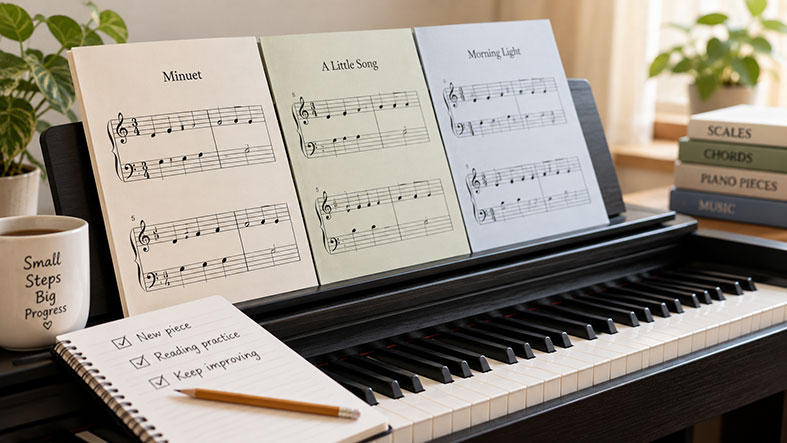
One way to check this is to open another piece at a similar level that I haven’t played before. If reading suddenly becomes difficult again, then I probably memorised the previous piece more than I realised.
For this reason, I think playing lots of short, relatively easy pieces can be extremely useful. Each new piece gives you another opportunity to practise reading without spending weeks learning difficult notes.
Easy Pieces Give You More Time to Listen
When I attempt something that is close to the limit of my ability, most of my concentration goes into simply keeping the piece moving. I am thinking about the next note, the fingering, where my hand needs to move and what the other hand is supposed to be doing.
There isn’t much attention left for listening.
With an easier piece, some of that pressure disappears. Once I am comfortable with the notes, I can listen more carefully to the rhythm, dynamics and balance between the hands.
I can ask whether the melody sounds smooth, whether the accompaniment is too loud or whether a phrase sounds natural. These are musical questions rather than questions about finding the correct keys.
For me, this is one of the biggest reasons not to rush through beginner repertoire.
Why I’m Interested in Czerny and Diabelli
This is also why I have become increasingly interested in composers such as Carl Czerny and Anton Diabelli. Both wrote music that can be useful for developing fundamental piano skills, and many of their easier works are accessible to learners.
At first, a short study or beginner piece can look almost too simple. However, once you start paying attention to rhythm, articulation, finger control and musical expression, there can be much more to work on than the number of notes suggests.
I particularly like the idea of using these pieces as a bridge between exercises and repertoire. Scales, chords and five-finger patterns are important, but it becomes much more interesting when you begin recognising those same patterns inside actual music.
Instead of practising a C major chord simply because it is something a beginner should know, you begin to understand why knowing that chord makes a piece easier to read and play.
Harder Doesn’t Always Mean Better
As an adult beginner, it is tempting to measure progress by the difficulty of the pieces I can play. If I move from a very easy piece to a harder one, it feels like obvious progress.
But I am beginning to think that this isn’t the only way to measure improvement.
If I can play a simple piece today with a steadier rhythm, better balance between my hands and fewer unnecessary pauses than I could several months ago, that is also progress. If I recognise a chord immediately instead of reading every note separately, that is progress too.
The difficulty of the piece is only one part of the picture. How well I can play it matters just as much.
Try Listening Differently to Your Next Piece
The next time you learn an easy piano piece, it may be worth continuing to practise it even after you can play all the correct notes.
Try listening to one thing at a time. First, concentrate on the rhythm and notice whether you slow down anywhere. Then listen to the balance between the hands. If the right hand has the melody, check whether you can hear it clearly above the accompaniment.
You can also listen for uneven notes and places where your hands become tense. Playing the piece a little more slowly can make these problems easier to notice.
A piece that initially seemed almost too easy may suddenly become a very useful exercise.
Beginner piano pieces are simple because they are designed for people who are still developing fundamental skills. That doesn’t mean those skills themselves are easy.
A short melody can teach finger control and phrasing. A few left-hand chords can teach balance and coordination. A simple rhythm can reveal whether you are really able to maintain a steady pulse. Even a piece that takes less than a minute to play can contain plenty to practise.
I’m learning not to judge my progress only by how difficult my repertoire becomes. There is also a lot of value in returning to simple music and noticing that I can now play it more comfortably, more evenly and with more attention to how it actually sounds.
Perhaps that’s one of the most useful lessons beginner music can teach us: the goal isn’t simply to play harder pieces. It’s to learn to play simple pieces better.