Ferdinand Beyer: Why His Piano Method Is Still Useful for Beginners
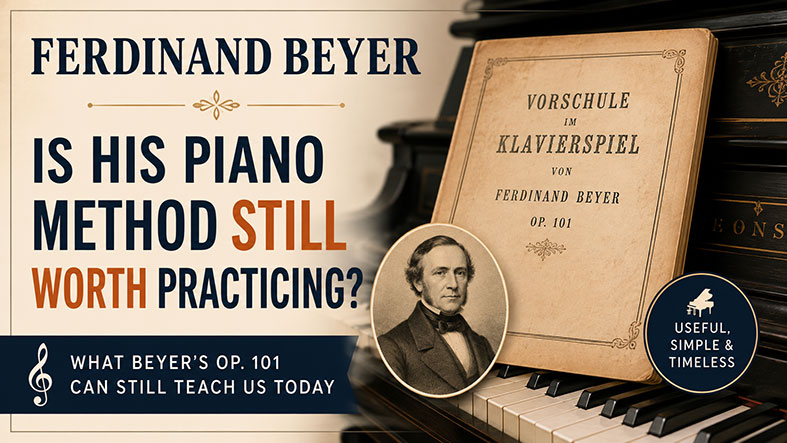
When learning piano today, it is easy to assume that newer teaching materials must automatically be better. Modern methods have many advantages, but some much older teaching material can still be surprisingly useful. One example is Ferdinand Beyer, a German pianist, composer and teacher best remembered for his beginner piano method Vorschule im Klavierspiel, Op. 101.
Beyer’s method was written in the nineteenth century, yet many of its exercises still address exactly the problems a new pianist encounters today: finding notes comfortably, coordinating the hands, keeping a steady rhythm and gradually becoming more confident at the keyboard. I wouldn’t use Beyer as a complete modern piano course, but I think selected exercises can still be very valuable, particularly for adult beginners.
Who Was Ferdinand Beyer?
Ferdinand Beyer was born in 1803 and became known as a pianist, composer, arranger and teacher. Although he produced a large amount of music, his lasting reputation is mainly connected with his educational works, especially Vorschule im Klavierspiel, Op. 101.
You can learn more about his life and music on my Ferdinand Beyer composer page. What makes Beyer especially interesting to me is not simply his biography, but the way his teaching material breaks piano playing into small and manageable steps.
What Is Beyer’s Op. 101?
Beyer’s Op. 101 is a progressive collection for beginning pianists. The material starts simply and gradually introduces more demanding skills. This approach makes sense because even a very easy piece can require a beginner to think about several things at once: notes, fingers, rhythm, hand position and what comes next.
By keeping the early material simple, Beyer gives the learner an opportunity to concentrate on fundamental skills without being overwhelmed. For an adult beginner, this can be particularly useful. Not every practice session needs to revolve around learning a difficult piece; sometimes a short exercise with one clear purpose is exactly what is needed.
Short Exercises Can Be Very Useful
One of the strengths of Beyer’s method is that many of the exercises are short and approachable. Instead of spending an entire practice session struggling through a long piece, you can work on a small section and concentrate on playing it accurately and evenly.
Short exercises also make progress easier to notice. Something that feels awkward on the first day may already feel more natural after several careful repetitions. These small improvements can be encouraging, especially during the early stages of learning when progress is not always obvious.
Repetition Doesn’t Have to Be Boring
Traditional piano methods can sometimes feel repetitive, and simply playing every exercise from beginning to end would probably become tedious for many adult learners. However, repetition itself is an important part of learning a physical skill. The key is to repeat with a purpose.
For example, you could play an exercise once while concentrating on the correct notes, again while paying attention to rhythm, and a third time while listening carefully to the quality of the sound. The notes remain the same, but each repetition has a different goal. This turns a simple technical exercise into more thoughtful practice.
Building Keyboard Familiarity and Coordination
Beyer’s exercises can also help develop familiarity with the keyboard. At first, the piano can seem like a large collection of almost identical keys, but gradually we begin to recognize its repeating patterns and move around it more naturally. Simple exercises provide opportunities to reinforce this familiarity without introducing too many new difficulties at once.
The same gradual approach can help with hand coordination. Playing with two hands is surprisingly demanding for a beginner because each hand may have a different role. Progressive exercises allow this coordination to develop in manageable steps rather than asking the learner to deal with complicated two-handed music immediately.
I Wouldn’t Use Beyer as My Only Piano Method
Despite these advantages, I wouldn’t recommend using Beyer’s Op. 101 as the only method for learning piano today. Modern learners have access to resources that didn’t exist in Beyer’s time, including recordings, interactive exercises, visual demonstrations, ear training and a much wider variety of beginner repertoire.
I therefore see Beyer as a useful practice resource rather than a complete curriculum. An adult learner can select exercises that develop a particular skill, practise them for a while and then apply that skill to other music. There is no need to complete every exercise simply because it happens to be the next one in the book.
Don’t Forget to Make the Exercises Musical
It is also worth remembering that an exercise doesn’t have to sound mechanical. Once the notes are comfortable, you can listen for an even sound, experiment with dynamics and think about the shape of the musical phrase. Even very simple material can be played with attention and musical intention.
This is something I find particularly useful about educational composers such as Beyer, Carl Czerny and Anton Diabelli. Their music can provide a bridge between learning basic technical skills and playing more substantial repertoire. The objective isn’t simply to complete exercises; it is to develop skills that make future music easier and more enjoyable to play.
Is Ferdinand Beyer Still Worth Practicing?
I think selected Beyer exercises are still worth practicing, especially for beginners who appreciate a gradual and structured approach. His method is old-fashioned in some respects, but the fundamental skills it develops haven’t disappeared: pianists still need keyboard familiarity, coordination, rhythm and control.
For an adult beginner, the best approach may be to combine exercises like these with modern learning materials and music you genuinely enjoy. Used this way, Beyer doesn’t need to become your entire piano education. Instead, his exercises can provide small, manageable challenges that help build the foundation for everything that comes later.