How Many Piano Pieces Should a Beginner Learn at the Same Time?
When I started learning piano, I thought the best approach was simple: choose one piece, practise it until I could play it, and then move on to the next one. It seemed logical, especially when even one beginner piece could take quite a lot of concentration.
Over time, however, I started to wonder whether working on only one piece was always the best way to practise. When you spend several weeks on the same music, your fingers gradually memorise it. You may become better at playing that particular piece, but you aren’t necessarily getting much practice at reading new music.
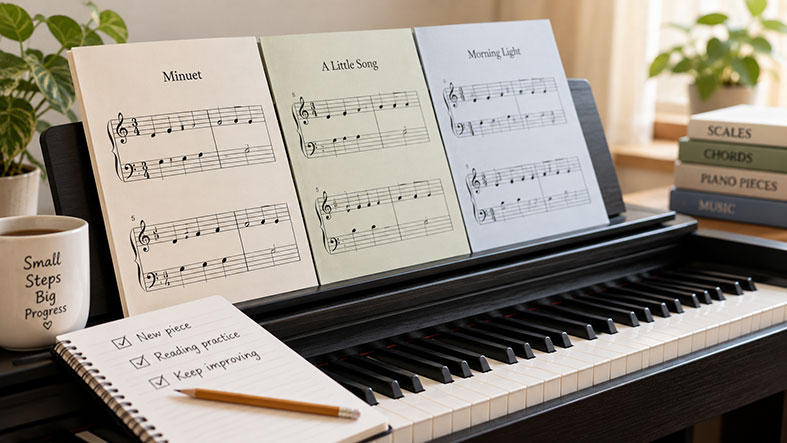
This made me think about a different approach. Instead of concentrating on only one piece, perhaps it is better to have two or three easy piano pieces in progress at the same time.
For many adult beginners, I think two or three pieces can be a good starting point. They don’t all need to be equally difficult, and they don’t all need to have the same purpose.
Why Learning Only One Piece Can Be Limiting
There is nothing wrong with concentrating on one piano piece, particularly when you have only just started learning. The problem appears when the same piece becomes almost your entire repertoire for several weeks.
After enough repetition, you naturally begin to remember what comes next. Your hands become familiar with the movements, and eventually you may be playing much of the piece from memory rather than actively reading the score.
This is useful for learning that particular piece, but it doesn’t necessarily provide much practice at reading unfamiliar music. If you want to become a better reader, you need to regularly encounter notes, rhythms and patterns that you haven’t already memorised.
Playing several short and appropriately easy pieces can provide more of that experience.
Different Pieces Can Have Different Purposes
I find it useful to think about beginner pieces as having different jobs. Not every piece needs to be something that you practise for weeks and eventually try to play perfectly.
For example, one piece can be your main learning piece. This might be slightly more challenging and require careful practice. You may need to work on individual measures, practise the hands separately and spend time understanding the rhythm.
A second piece can be easier and used mainly for reading and fluency. You don’t necessarily need to polish it. The goal can simply be to read the music, recognise familiar patterns and keep going without stopping too often.
A third piece can be something you already know reasonably well. Because you are no longer struggling to find the notes, you can use it to work on rhythm, dynamics, balance and musical expression.
In this way, you are still practising only a small amount of music, but each piece helps you develop something different.
One Piece Can Be Your Main Challenge
Your main piece should probably be the most challenging of the two or three, but that doesn’t mean it should be extremely difficult. Ideally, it should introduce one or two things that require more attention while still feeling achievable.
Perhaps the left hand has a new chord pattern. Maybe the hands need to play together in a way that feels unfamiliar, or the rhythm requires more concentration than usual.
This is the piece where slow and careful practice can be particularly useful. You might work on only a few measures at a time and gradually put the sections together.
If nearly every measure feels like a major challenge, however, the piece may simply be too difficult for your current level. A beginner piece should teach you something new without making every practice session feel like a struggle.
Another Piece Can Be Easier
I think there is a lot of value in playing music that feels relatively easy. As beginners, we often assume that we need increasingly difficult pieces in order to improve, but easier music allows us to practise different skills.
When you aren’t struggling to find every note, you can pay more attention to maintaining a steady rhythm. You can try to look ahead in the score, recognise intervals and notice familiar chord shapes.
You may also find it easier to continue playing after a small mistake instead of stopping and starting again. That is an important skill that can be difficult to develop when the music is too challenging.
An easy piece doesn’t have to stay in your practice routine for very long. After a few days, you may decide that you have learned what you needed from it and replace it with another one.
Keep Something You Already Know
It can also be useful to keep one familiar piece in your practice routine. This gives you an opportunity to concentrate less on finding the notes and more on how the music actually sounds.
Once the notes are comfortable, you can listen to whether the rhythm is steady and whether the melody can be heard clearly. You can also work on dynamics, articulation and the balance between the hands.
This is something I have started to appreciate more as an adult beginner. A piece doesn’t stop being useful simply because I can play all the correct notes.
Sometimes the most interesting practice begins after the notes have become easy.
What If You Have Only Just Started Learning Piano?
If you are a complete beginner, you certainly don’t need to start with three pieces. Even a very short piece can require a lot of concentration when you are still learning where the notes are and how to coordinate your fingers.
In that situation, one or two short pieces may be enough. As reading becomes easier and you become more comfortable at the keyboard, you can gradually introduce more music.
The number of pieces is much less important than their difficulty. Three very short pieces at the right level may actually be easier to manage than one piece that is far too advanced.
Your practice should feel challenging enough to be interesting, but not so difficult that you spend most of the time frustrated.
Don’t Choose Three Difficult Pieces
If you decide to work on several pieces, I wouldn’t choose three pieces that are all at the limit of your ability. That would simply give you three difficult problems instead of one.
A better combination might be one piece that challenges you slightly, one piece that feels comfortable and one familiar piece that you can already play reasonably well.
This creates variety without making your practice overwhelming. It also allows you to experience the satisfaction of actually playing music instead of spending the entire session trying to solve difficult measures.
I am increasingly convinced that beginner pianists don’t always need harder music. Sometimes we simply need more experience playing music at the right level.
Playing More Easy Pieces Can Improve Your Reading
One of the biggest advantages of learning several short pieces is the amount of new music you get to read.
Imagine spending three months learning only three or four difficult pieces. You may practise for many hours, but you have only had a few opportunities to open an unfamiliar score and work out what it means.
Now imagine playing many short and easy pieces during the same period. Every new piece gives you another opportunity to recognise notes, intervals, rhythms, chords and other familiar patterns.
Over time, you may begin to see groups of notes rather than reading every note individually. C, E and G may start to look like a C major chord rather than three separate pieces of information.
A melody moving step by step may also become something you recognise immediately instead of having to identify every note separately.
This kind of familiarity can make reading new music much less intimidating.
Short Classical Pieces Are Very Useful
This is one reason I have become interested in the beginner music of composers such as Carl Czerny, Anton Diabelli and Ferdinand Beyer. They wrote a large amount of music for students, including many short pieces and exercises.
Some of these pieces may look very simple, but they can still introduce useful musical ideas. One might concentrate on five-finger movement, while another uses simple chords or asks the two hands to perform different roles.
Short pieces also allow beginners to experience more music. Instead of spending months preparing one difficult composition, you can encounter many different rhythms, hand positions and musical patterns.
For me, this creates a useful connection between exercises and actual repertoire. Scales, chords and five-finger patterns become more meaningful when I begin to recognise them inside the music I am playing.
Do You Need to Finish Every Piano Piece?
Another question is what it actually means to finish a piece. I don’t think every beginner piece needs to be practised until it is completely polished.
Some pieces are worth keeping for longer because you enjoy them or because they contain something you want to improve. You might spend more time working on the rhythm, dynamics or balance between the hands.
Other pieces may simply be useful for reading practice. Once you have played them several times and become familiar with the music, it may be more beneficial to move on to something new.
The important question is not simply whether you can play the piece. It is also why you are still practising it.
If you know what you are trying to improve, continuing to work on the piece makes sense. If you are only repeating it because you feel that you should, perhaps it is time to try something different.
A Simple Way to Organise Your Piano Practice
You don’t need a complicated practice schedule to work on several pieces. A simple rotation can be enough.
You could start with your main piece and spend some time working carefully on the sections that need attention. After that, you could play an easier piece and concentrate on reading smoothly and maintaining a steady rhythm.
Finally, you could return to a familiar piece and focus on making it sound better. Because you already know the notes, you can listen more carefully to dynamics, phrasing and balance.
You can still include scales, chords, note-reading exercises or other technical practice. The pieces simply give you a place to use some of those skills in actual music.
Quality Is More Important Than Quantity
Learning several pieces doesn’t mean trying to play as many as possible. There is little benefit in rushing through a large number of pieces if the rhythm is always uneven and mistakes are ignored.
The goal isn’t to collect pieces. It is to gain experience with different kinds of music while developing better reading, coordination and listening skills.
Some pieces deserve more attention than others. Some can remain in your repertoire for weeks, while others may be useful for only a few practice sessions.
Having several pieces available simply gives you more opportunities to practise different skills.
So, How Many Piano Pieces Should a Beginner Learn at Once?
For many adult beginners, I think two or three piano pieces at the same time is a sensible place to start.
One can be your main learning piece and provide a small challenge. Another can be easier and used for reading practice. If you want a third, it can be something familiar that allows you to concentrate on playing more musically.
If you have only just started learning piano, one or two pieces may be enough. As your reading and coordination improve, you can gradually explore more music.
There isn’t a perfect number that works for everyone. The level of the pieces and what you are trying to learn from them are much more important.
As an adult beginner, I used to think that progress meant finishing one piece and then moving on to something slightly more difficult. The harder the music became, the more progress I thought I was making.
I am beginning to see progress differently. Playing more music at an appropriate level can give us more opportunities to practise reading, recognise patterns and become comfortable using both hands.
A new piece can challenge us. An easier piece can improve our reading and fluency. A familiar piece can help us listen more carefully and learn to play with better rhythm, balance and expression.
Perhaps we don’t always need to ask, “What harder piece should I learn next?”
Sometimes a better question is, “What can I learn from the pieces I am playing now?”