Why Czerny Is Still Worth Practicing as an Adult Beginner
When I first came across the name Carl Czerny, I associated him mainly with exercises: pages of notes designed to make your fingers move faster and more evenly. That didn’t sound particularly exciting. As an adult beginner, there are already so many things to learn. Reading notes, coordinating both hands, understanding rhythm, learning scales and chords, and simply trying to play a piece from beginning to end can take a lot of concentration. So why spend valuable practice time on exercises written around 200 years ago?
The more I explore Czerny’s music, however, the more I understand why pianists are still practicing it today. His pieces seem to provide something particularly useful for beginners: a bridge between technical exercises and playing real music. Instead of practising a scale or finger pattern in isolation, you encounter many of the same technical challenges inside a short musical piece.
Who Was Carl Czerny?
Carl Czerny was an Austrian pianist, composer and teacher born in Vienna in 1791. He studied with Ludwig van Beethoven and later became an influential teacher himself. His most famous pupil was Franz Liszt, who would go on to become one of the greatest virtuoso pianists of the nineteenth century.
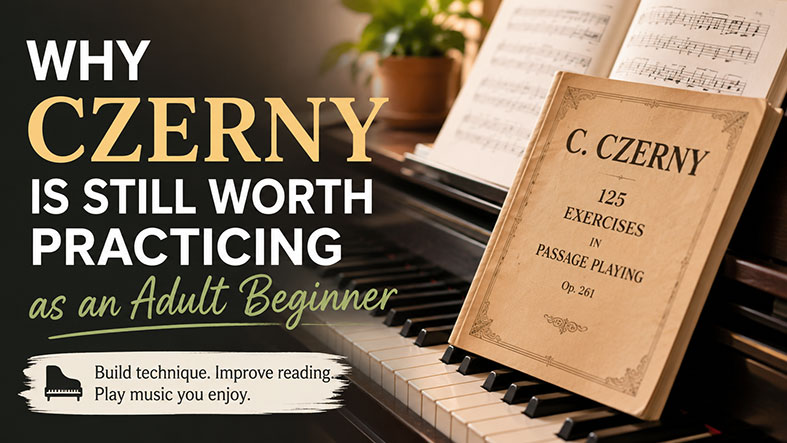
Czerny composed an enormous amount of music, but today he is particularly well known for his piano studies and exercises. Collections such as Practical Method for Beginners, Op. 599, 125 Exercises in Passage Playing, Op. 261, The School of Velocity, Op. 299 and The Art of Finger Dexterity, Op. 740 cover a huge range of difficulty. Some are clearly intended for advanced pianists, but many of the shorter studies are accessible to developing players and concentrate on surprisingly specific skills.
Short Exercises With a Clear Purpose
One thing I particularly like about short Czerny studies is that they don’t try to teach everything at once. A piece might concentrate primarily on an even five-finger pattern, while another introduces repeated notes, simple accompaniment, changing hand positions or a particular rhythmic pattern. This makes the purpose of the practice much easier to understand.
Instead of sitting down at the piano with the very vague goal of becoming a better pianist, I can work on something much more concrete, such as playing four measures evenly without stopping. For an adult beginner, I think that distinction matters. Piano can sometimes feel overwhelming because so many skills are developing simultaneously. A short study gives me a smaller problem to solve, and solving lots of small problems is eventually what allows us to tackle more complicated music.
Somewhere Between an Exercise and a Piece of Music
I practise scales, chords and other technical exercises, and I think they are useful. At the same time, playing a scale doesn’t always feel like playing music. A Czerny study is different because the technical pattern exists within an actual piece. There is a beginning and an ending, and there are phrases, rhythms and changes in harmony.
This means that I have to do more than simply move my fingers through a familiar pattern. I have to read the score, maintain the pulse, coordinate both hands and continue through the music without constantly stopping. That is much closer to what happens when playing repertoire, and for me it is one of the strongest arguments for including Czerny in my practice.
Short Pieces Make Progress Easier to See
As an adult learner, I find short pieces particularly satisfying because they make progress easier to notice. When a piece is only a few lines long, I can concentrate on a small section, repeat it and actually hear whether it is becoming more comfortable. That improvement isn’t always as obvious when working on a much longer piece for several weeks.
A short study also allows me to experience the entire learning process relatively quickly. I can begin by reading it slowly, practise individual measures, connect those measures into longer sections and eventually try to play the whole piece without stopping. Learning piano is a long process, so having smaller pieces that I can actually finish gives me regular evidence that I’m moving forward.
Czerny as Reading Practice
Another reason I’ve become interested in Czerny is reading music. It’s very tempting as a beginner to keep playing pieces containing familiar notes and patterns, particularly once muscle memory begins to take over. Short studies continually present slightly different combinations of notes, rhythms and hand positions, which means I have to keep paying attention to the score.
I find myself asking questions such as: Where does the melody move next? Has my hand position changed? Is the next note a step or a leap? What is happening in the following measure? Rather than memorizing a single exercise and repeating it indefinitely, I’m continually interpreting musical notation. I’m not interested only in learning how to play a handful of pieces; I want to become better at reading and understanding music at the piano, and short studies provide plenty of material for doing that.
Finger Independence — Without Chasing Speed
One of the strange discoveries when learning piano as an adult is realizing that your fingers don’t always want to behave independently. Sometimes I know exactly which note I want to play and which finger should play it, yet another finger seems determined to join in. Czerny’s exercises frequently use repeating patterns that require different fingers to perform similar movements evenly, and at a slow tempo those patterns can reveal weaknesses very clearly.
Perhaps fingers four and five aren’t as controlled as the others, one hand is considerably more comfortable than the other, or everything works until both hands have to play together. For me, the goal isn’t immediately to play these exercises quickly. Control comes first. I’d rather play a pattern slowly, evenly and without unnecessary tension before worrying about increasing the tempo.
This is also where a metronome can become genuinely useful. Instead of immediately trying to reach a target tempo, I can find a speed at which I can play comfortably and accurately. Once that becomes easy, I can increase the tempo slightly. In that sense, the metronome isn’t there to force me to play faster; it’s a way of measuring whether I’m becoming more comfortable and consistent.
Practising Czerny Measure by Measure
One of the things I’m experimenting with in my own piano practice is breaking pieces into very small sections. Instead of repeatedly starting at measure one and hoping to somehow reach the end, I can concentrate on the exact place where I’m struggling. I might practise measure one, then measure two, connect measures one and two, work separately on measure three, and eventually connect measures two and three.
Short Czerny studies seem particularly well suited to this approach because they are often built from patterns. Once I understand what is happening in one measure, I can start recognising how that idea changes or repeats later in the piece. It also makes difficult passages seem much less intimidating. Four problematic measures become four individual problems rather than one large problem called “I can’t play this piece.”
This is one of the reasons I’ve started adding Czerny pieces to my Piano Library. I want to experiment with learning from the score in a more interactive way: listening to the music, following the notation and practising individual measures or sections instead of treating the entire score as one large block.
Are Czerny Exercises Boring?
Czerny has a reputation for being boring, and I can understand where that comes from. If I play the same exercise mechanically twenty times while thinking about something else, it probably will become boring — and I’m probably not getting very much from those repetitions either.
I’ve found it more useful to give each repetition a purpose. One attempt might concentrate on rhythm, the next on fingering and another on keeping one hand relaxed. I might then try playing the section without looking at my hands or use a metronome to see whether I can maintain a consistent pulse. The notes haven’t changed, but the purpose of the repetition has, and that makes practice much more interesting.
Does Every Adult Beginner Need Czerny?
I don’t think every adult beginner needs to practise Czerny. There are many ways to learn piano, and I don’t believe there is a single collection of exercises that everyone must use. If you love learning through songs, arrangements or other repertoire, there’s no reason to abandon them and spend your entire practice session playing nineteenth-century studies.
For me, Czerny occupies a useful place alongside scales, chords, sight-reading and repertoire, rather than replacing any of them. Even five or ten focused minutes on a short study can give me something specific to work on. Because there are so many Czerny exercises at different levels, I can also choose something appropriate for where I am now instead of struggling through material that is far beyond my current ability.
Why I’m Keeping Czerny in My Practice
The biggest reason is quite simple: Czerny gives me small, manageable musical problems to solve. As an adult beginner, that’s exactly what I need. I don’t need to prove how quickly I can play an exercise, complete hundreds of studies or practise them exactly as a nineteenth-century piano student might have done.
Instead, I can use them for what they are good at. One short piece can help me practise reading, another can expose a weakness in my fingering, and another can help with coordination between my hands. Sometimes a study simply gives me the satisfaction of taking something that I couldn’t play comfortably yesterday and being able to play it a little better today.
That’s why, almost two centuries later, I think Carl Czerny is still worth practicing as an adult beginner.
Explore Czerny With Me
I’m gradually adding Carl Czerny’s pieces to my Piano Library, where I’m experimenting with a more interactive approach to learning them. Rather than only looking at a score, I want to be able to listen to the piece, follow the music and practise individual measures or sections at my own pace.
If you’re also learning piano as an adult, you can explore these pieces with me and use them as short technical challenges alongside your regular practice. Because sometimes progress at the piano doesn’t come from tackling a bigger and more impressive piece. Sometimes it comes from finally playing those four difficult measures a little better than you played them yesterday.