
C Major Scale for Piano Beginners
The C major scale is usually the first piano scale beginners learn. It is simple, easy to understand, and helps build a strong foundation for piano playing and music theory. Because the C major scale uses only white piano keys, it allows beginners to focus on finger movement, rhythm, and hand coordination without worrying about sharps and flats. Learning the C major scale can improve your piano technique, strengthen your fingers, and help you understand how music works.
What Is the C Major Scale
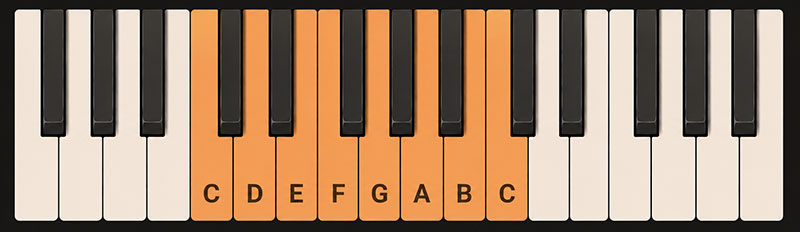
For many piano students, the C major scale becomes the foundation for learning other scales later. Because C major has no sharps or flats, it is one of the easiest scales for beginners to understand. The C major scale is a sequence of eight notes played in order from low to high. The notes of the C major scale are:
C – D – E – F – G – A – B – C
All of these notes are played on white piano keys. The scale starts on C and ends on the next C one octave higher.
C Major Scale Notes
Interactive guide to the notes, intervals, and keyboard pattern of C major.
| Scale Degree | Note | Solfege | Interval from C |
|---|
Printable Version
Free printable C Major Scale PDF – perfect for piano students, teachers, and music learners.
📄 Download PDFWhy Beginners Start with the C Major Scale
The C major scale is one of the easiest scales to understand visually on the piano keyboard.
- Uses only white keys
- No sharps or flats
- Easy to memorize
- Helps develop finger coordination
- Builds confidence for beginners
- Introduces basic music theory
C Major on the Keyboard
C Major Scale Notes
Click a piano key to see the matching note on the staff.
C Major Scale Notes — Bass Clef
Click a piano key to see the matching note on the bass staff.
The C major scale uses only white keys. Start on C, then move step by step through each white key until you reach the next C.
C Major on the Staff
On the staff, the C major scale moves upward one note at a time. Each note appears on the next line or space.
Chords in C Major Scale
| Scale Degree | Chord | Notes | Quality |
|---|---|---|---|
| I | C major | C – E – G | Major |
| ii | D minor | D – F – A | Minor |
| iii | E minor | E – G – B | Minor |
| IV | F major | F – A – C | Major |
| V | G major | G – B – D | Major |
| vi | A minor | A – C – E | Minor |
| vii° | B diminished | B – D – F | Diminished |
The most important beginner chords in C major are:
- C major — I chord
- F major — IV chord
- G major — V chord
These three chords are used in countless songs and help connect scale practice with real music.
C Major Scale Fingering
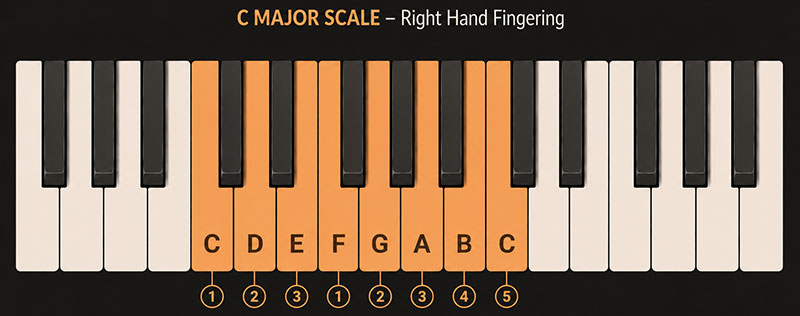
Right Hand
1 – 2 – 3 – 1 – 2 – 3 – 4 – 5
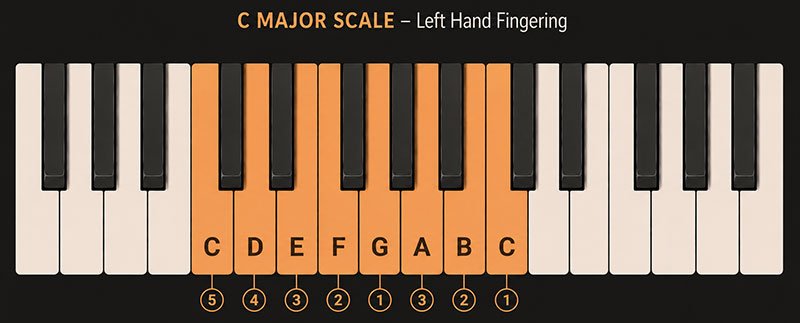
Left Hand
5 – 4 – 3 – 2 – 1 – 3 – 2 – 1
Practise slowly at first. The goal is not speed — the goal is smooth movement, relaxed hands, and even rhythm.
Right Hand Fingering for the C Major Scale
Using the correct fingering helps your hand move smoothly across the keyboard. The right hand fingering for the C major scale is: 1 2 3 1 2 3 4 5
Your thumb goes under your hand after the third note to continue the scale smoothly. At first this movement may feel unusual, but it becomes natural with practice.
Left Hand Fingering for the C Major Scale
The left hand uses a different fingering pattern. The left hand fingering is: 5 4 3 2 1 3 2 1. Your middle finger crosses over the thumb during the scale. Practice slowly so your movements stay relaxed and comfortable.
How to Practice the C Major Scale
Many beginners try to play scales too quickly. Slow practice usually gives better results.
- Practice slowly
- Keep a steady rhythm
- Relax your hands
- Use correct fingering
- Focus on accuracy
- Practice every day
Even a few minutes of daily scale practice can improve your coordination and confidence.
Practice One Hand at a Time
Beginners often find it easier to learn scales one hand at a time before combining both hands together. This allows you to focus on fingering, rhythm, and smooth hand movement more comfortably. Once both hands feel confident separately, try playing the scale with both hands together slowly.
Use a Metronome
A metronome helps you keep a steady rhythm while practicing piano scales. Start at a slow tempo and increase the speed gradually as your confidence improves. Do not rush. Good technique is more important than fast playing.
How the C Major Scale Helps Piano Beginners
Practicing the C major scale regularly can improve many important piano skills.
- Finger strength
- Hand coordination
- Rhythm control
- Keyboard awareness
- Music reading skills
- Understanding of music theory
The C major scale also prepares beginners for learning chords, songs, and more advanced scales.
Common Mistakes Beginners Make
Learning scales takes patience. Beginners often make a few common mistakes when practicing.
- Playing too fast
- Using incorrect fingering
- Tensing the hands
- Skipping slow practice
- Ignoring rhythm
- Practicing inconsistently
Focusing on relaxed and steady practice will help you improve much faster.
Frequently Asked Questions
What notes are in the C major scale?
The C major scale contains the notes C D E F G A B C.
Why is the C major scale easy for beginners?
The C major scale uses only white piano keys and does not include sharps or flats.
How often should I practice the C major scale?
Daily practice is best. Even five to ten minutes each day can improve technique and coordination.
Should I practice scales with both hands?
Yes, but beginners should usually practice one hand at a time first before combining both hands together.
What comes after learning the C major scale?
Many beginners continue with G major scale, F major scale, chords, rhythm exercises, and simple piano songs.
Can adults learn the C major scale?
Yes. Adults of all ages can successfully learn piano scales with regular and patient practice.
Practice Exercise
- Play the C major scale hands separately.
- Use correct fingering.
- Practise one octave slowly.
- Keep a steady beat.
- Then try hands together when ready.
C Major MIDI Staff Trainer
Connect your MIDI keyboard, press the notes C – D – E – F – G – A – B – C, and watch the staff highlight as you play.
C Major Scale Quiz
Answer 10 beginner-friendly questions about the C major scale.
Click-to-Play Piano – C Major Scale
Click any key to hear the note and see it on the staff.