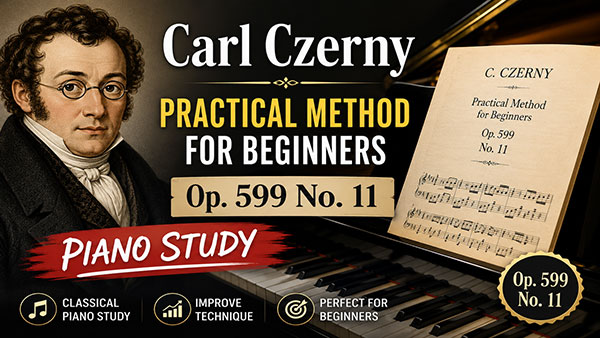
Carl Czerny Practical Method for Beginners Op. 599 No. 11 is one of the most useful studies for developing a solid piano technique. Although it is written for beginners, it teaches skills that every pianist will continue to use throughout their musical journey.
If you are teaching yourself to play the piano, this exercise is an excellent choice. It is not simply about pressing the correct keys. It helps you build coordination, accuracy, rhythm, finger independence, and confidence. These are the foundations that make learning more advanced music much easier later.
Many adult beginners believe that technical exercises are boring. I had similar thoughts when I first started learning piano. However, after spending time with Czerny’s studies, I discovered that every exercise has a clear purpose. Each lesson develops one or more important musical skills.
The greatest benefit is that the improvements you make while practicing this piece will also appear when you play other music.
- Main skills developed include finger independence, even rhythm, hand coordination, note reading, and control of touch.
Technical Analysis of Op 599 No 11
At first glance, this study looks simple. The notes are not difficult to read, and the rhythm is straightforward. The real challenge is to play everything evenly while keeping both hands relaxed.
One of the first technical goals is maintaining equal strength in every finger. Beginners often press some keys much harder than others. This creates an uneven sound that makes the music less fluent.
This exercise teaches you to produce an even tone from the first note to the last.
The right hand usually carries a simple melodic pattern while the left hand provides an accompanying figure. Both hands must work independently without becoming tense.
Finger coordination is another important aspect. Each finger must move confidently without unnecessary movement from the wrist, elbow, or shoulder.
Good posture also plays an important role. Sit comfortably, keep your shoulders relaxed, and allow your wrists to stay flexible. Many technical problems disappear simply by reducing unnecessary tension.
The tempo should remain steady throughout the exercise. Beginners often slow down during difficult passages and speed up during easier ones. Practicing with a metronome can help you develop a consistent pulse.
Instead of aiming for speed immediately, focus on producing a beautiful, controlled sound.
Practice Benefits for Self Taught Pianists
One reason I recommend Op. 599 No. 11 is that it teaches several important skills at the same time.
Every practice session strengthens your ability to recognise notes quickly while improving hand coordination. After several days of practice, you will probably notice that reading music becomes easier.
This study also develops muscle memory. Repeating the same movements correctly helps your fingers become more comfortable at the keyboard.
Many beginners try to play from memory too early. I recommend reading the score carefully every time until you can recognise the notes without hesitation.
Slow practice is one of the biggest secrets of successful learning.
When you practice slowly, your brain has enough time to understand every movement. This reduces mistakes and builds reliable technique.
Another valuable lesson from this piece is patience.
There will be days when your progress feels slow. That is perfectly normal. Piano playing is built through hundreds of small improvements rather than one big breakthrough.
As an adult learner, I have learned that consistency always beats long but irregular practice sessions.
Even fifteen or twenty focused minutes every day will produce better results than practicing for several hours only once a week.
Common Mistakes Beginners Make
Many students experience similar difficulties while learning this exercise.
The first mistake is trying to play too fast.
Fast playing hides technical problems instead of solving them. Every wrong movement becomes harder to correct later.
The second mistake is looking only at the hands.
Try to keep your eyes on the sheet music as much as possible. This improves your reading ability and helps prepare you for more advanced pieces.
Another common problem is uneven rhythm.
If one measure feels difficult, isolate it and repeat it several times before reconnecting it with the surrounding phrases.
Some beginners also lift their fingers too high above the keyboard. While finger independence is important, exaggerated movements create unnecessary tension.
Aim for small, economical finger movements that remain close to the keys.
Relaxation should always be one of your priorities.
Whenever you notice tension in your shoulders, wrists, or fingers, stop for a moment and reset your posture before continuing.
Why Adult Beginners Should Learn Czerny
Many adults worry that they started learning piano too late.
Fortunately, piano does not depend only on age. It depends much more on regular practice, curiosity, and persistence.
Carl Czerny’s beginner studies are ideal because they provide clear, measurable progress. Every exercise teaches something new while remaining accessible for independent learners.
Completing Op. 599 No. 11 gives you confidence that you are building genuine technical skills rather than simply memorising one piece.
This confidence becomes very important when you move on to composers such as Bach, Mozart, Beethoven, Schumann, or Chopin.
Their music requires exactly the same technical foundations that Czerny carefully develops.
That is why generations of piano teachers continue recommending these studies.
My Advice for Learning Op 599 No 11
When I practice this study, I always remind myself that quality is more important than quantity.
I begin at a comfortable tempo where every note feels completely under control.
Only after I can play the entire exercise accurately several times do I increase the speed slightly.
Recording yourself is another excellent learning tool.
Listening back often reveals uneven rhythm, inconsistent dynamics, or moments of tension that are difficult to notice while playing.
I also recommend dividing the piece into small sections.
Master one phrase before moving to the next.
Finally, remember that this exercise is not simply another page in a method book.
It is a carefully designed lesson that develops the technique you will use throughout your entire musical journey.
Whether you are teaching yourself, returning to piano after many years, or finally following a lifelong dream, Carl Czerny Practical Method for Beginners Op. 599 No. 11 is an excellent investment in your future as a pianist.
Every correctly played note strengthens your technique. Every careful practice session increases your confidence. Every small improvement brings you one step closer to becoming the musician you want to be.
Keep practicing, stay patient, and enjoy the process. The journey is just as rewarding as the destination.